

This guide helps houses of worship (HOW) evaluate solar photovoltaic systems in Massachusetts as of summer 2026. Key takeaways:
Since it will take a number of months for a congregation to evaluate a solar photovoltaic project, select a solar partner, install the system, and receive the utility company’s approval to connect the system to the grid, congregations that are interested in solar panels should get started ASAP to ensure they can qualify for the Federal “direct pay” incentive. MassIPL and our solar partners have helped more than 50 houses of worship install solar. Contact us at solar@massipl.org.
Solar panels provide a renewable source of electricity that emits no climate-change-causing emissions. This is reason enough for people of faith to consider installing solar but, of course, there are financial realities that houses of worship (HOW) face.
On the one hand, solar panels require a significant investment. On the other hand, prices for gas and oil continue to rise and are highly volatile due to geopolitical events such as the wars in Ukraine and Iran; this creates challenges for house of worship budgets. One way to think about an investment in solar panels is that they pre-purchase the next 20–25 years of electricity at a fixed price. The good news is that the cost of solar photovoltaic systems (solar panels that produce electricity) has dropped significantly over the past decade, making solar an increasingly attractive investment for many congregations. Depending on system size, electricity usage, and site conditions, many projects can achieve payback periods of eight years or less. In the past, financing options have been the most popular, but direct purchase has become more feasible due to the “direct pay” provision of the Inflation Reduction Act enacted in August 2022.
To illustrate the different financing options, this paper will use the following example, based on MassIPL’s experience and approximate costs as of summer 2026.
Since solar panels will last at least 20 years, a HOW considering installing them should compare the economics of solar to the business-as-usual case of continuing to buy electricity from their utility over this time period.
The example HOW can expect to spend from $200,000 (if prices moderate and annual rate increases are modest) to $320,000 (if current prices remain and rate increases continue at the average annual rate of 5.7% seen since 2014). This compares quite favorably to the $75,000 cost of the system even if no state or federal incentives are available.
There are three financial benefits to consider in evaluating the financial aspect of solar panels:
In many cases, yes. For our example house of worship, the electricity savings alone (assuming a modest 3% annual increase in electricity costs) would pay back the $75,000 cost of the system in year 9. Because solar panels are typically warranted for 20–25 years and will continue producing power beyond that, the house of worship will realize years of reduced energy costs after recovering their initial investment. For this reason, solar may remain worth considering even if incentive programs are reduced or eliminated, though the exact economics will vary by site and electricity usage.
In many of our discussions with HOWs about solar, we hear the objection that a breakeven period as long as 8 years is not a good ROI. MassIPL respectfully disagrees. Often in our private or business lives, we judge investments on shorter time horizons, looking for a 4–5 year breakeven, but we feel HOWs should take a different perspective for 3 reasons:
Finally, ask your solar contractor to calculate the ROI for your specific project. To get an apples-to-apples comparison between proposals, specify the following assumptions to the contractor: utility inflation rate (Massachusetts historically averages 3–5% annually), annual maintenance costs (typically minimal, but include inverter replacement estimated at $1,500–$2,500 around year 12–15), and solar production decrease with age (standard industry assumption is 0.5% annual degradation). A qualified installer can provide a full financial model including internal rate of return (IRR) and net present value (NPV) based on your congregation’s specific electricity usage and site conditions.
For many HOWs, raising $50,000–$100,000 for solar panels is somewhat daunting. Fortunately, purchasing the panels directly is only one of several options available today. Determining the right way to finance a solar panel system is often the hardest part of the project: No single financing approach works for every HOW and considering which approach is best for your HOW’s situation is important. We review the most common options below and are happy to consult with our members as they evaluate them.
Solar panels have been eligible for tax credits for many years but, as tax-exempt organizations, HOWs have not been able to take advantage of this – until now. The IRA specifies that tax-exempt entities can now receive a “direct payment” for 30% of the cost of the solar panels – i.e., the US Treasury will send a check for $22,500 to our example HOW, reducing the cost of the system from $75,000 to $52,500. (Note: the Internal Revenue Service uses the term “elective pay” but it is the same provision.) The HOW will be required to register their system through their account on the IRS web site (or create an account if you don’t already have one) when it is installed and receive a registration number, then file a tax return for that tax year, even if they don’t normally file a tax return. Your solar installer will likely help guide you through this process. You can also refer to the following resources:
There are two other potential incentives that can further increase the direct pay amount, if you can qualify:
Note: Federal incentive programs are subject to change. As part of the proposal process, our solar partners will help you understand current eligibility requirements and project timelines.
The easiest, and in the long run, most financially beneficial approach, is to purchase the system. Our example house of worship which receives full net metering, 30% Federal “direct pay” rebate, and $0.03/kWh SMART 3.0 incentive would see the system break even in year 6.
Houses of worship with an endowment should first evaluate borrowing from these funds to install the system and use the savings and SMART or REC payments to repay the endowment. As noted above, conservative investments like government bonds or certificates of deposit likely pay 5% or less while an investment in a solar system will likely generate the equivalent of 9% or more.
Advantages: Highest savings, simplest to understand and execute.
Factors to consider: Requires money upfront, either by congregational donations, borrowing from the endowment or taking out a loan (see below). As owner of the system, the congregation is responsible for maintenance of the system, but this should not be a major obstacle. Solar panels require very little maintenance; the major maintenance item that can be expected is replacing a component called an inverter after about 15 years, which may cost $3,000–$5,000 depending on the size of the system and the future changes in pricing for this piece of equipment; consider setting up a reserve fund to anticipate this replacement and fund it from the energy savings. You may want to pay for an annual inspection, as you do for a heating system or other major piece of equipment, and your solar installer will likely offer you an annual service contract at a modest cost.
The purchase of a system may be financed by a loan. The combination of electricity savings and the SMART or REC incentive is likely to provide enough income to cover the monthly payments on a 15-year loan carrying up to a 7% interest rate, meaning this loan would not affect the annual budget. Using the Direct Pay rebate of $22,500 as a prepayment of the loan in Year 2 would result in paying off the loan in 9 ½ years instead of 15. Some denominations offer reduced-rate loans, often 4% or lower; at this rate, your house of worship could save around $1,000 per year, depending on the term of the loan – see the Resources section for a list of denominational loan sources.
Advantages: Simpler to understand and execute than methods involving additional parties (such as a power purchase agreement explained below) and long term likely provides greater savings. After the loan payoff, 100% of the savings belong to the house of worship for the remainder of the 25+ year life of the system.
Factors to consider: The interest rate limits savings in the initial years and the interest rate will determine how long it will take to pay off the loan.
If a HOW is not able to purchase the panels, various models known as “third party ownership” or “power purchase agreement” have evolved where a financing company owns the system for the period of time specified in the contract.
This remains a common approach for houses of worship that prefer little or no upfront cost. The house of worship pays nothing upfront: An outside company owns and installs the system, takes advantage of state and federal incentives, and the house of worship only pays for the electricity the system produces. Typically, the cost of the electricity is guaranteed to be 10% (sometimes as much as 15%) below the going utility rate for the 15–20 year life of the agreement. The important terms to evaluate are the starting cost per kWh, what if any inflation adjustment is included (and whether this adjustment is a set annual rate (usually 1%–3%) or is tied to increases in the electricity rate of your utility), and terms for buying the system prior to the end of the contract. MassIPL’s solar partners offer PPAs, if a system meets their size requirements.
Advantages: Immediate savings, no money required upfront, the PPA company has responsibility for maintenance of the system. The PPA company has one or more installers that they work with regularly, so the congregation does not need to seek their own installer. Ability to own the system, either at the end of the contract or earlier.
Factors to consider: Requires a 15–20-year contract with the PPA company and results in lower savings than owning the system; these contracts are long and require careful review. Requires a relatively large system, at least 30 kW, and often 40 kW or more. These contracts often allow you to buy the system at a depreciated price, often as early as year 6 following installation, providing the HOW a path to ownership of the system.
As batteries come down in price, more HOWs are considering installing them with their solar panels. We won’t cover them in detail here but they are worth discussing with solar installers who provide proposals to you. While they will add significant cost to the project, there are additional incentives that will offset part of this cost:
Given the urgency of climate change today, it is imperative that faith communities do all they can to address climate change and installing solar panels makes a significant contribution. With this range of financing options available, houses of worship have choices that will enable them to find one that fits their circumstances. Massachusetts Interfaith Power & Light has advised over 50 members on their solar projects and will help you! Contact solar@massipl.org.
Below are links and contacts to MassIPL solar partners and the organizations mentioned above:
MassIPL partners with five solar firms and a solar marketplace provider. If you work with one of these providers, be sure to mention you heard of them through MassIPL and they will make a donation to support our work if you sign a contract with them:
This is a solar marketplace: an online site where you set up a free account, list your property, put in some information about your electric utility and monthly/annual kilowatt hours and subscribing installers contact you if they are interested in the project. An easy way to find multiple installers and get multiple quotes.
Many denominational organizations offer loans for building projects, often at below-market rates. MassIPL is aware of the following denominational loan programs but if your denomination isn’t listed, do some research to see if they offer one.
Want to print, share, or view this article offline? Click the link below to download it as stand-alone file.


A step-by-step guide to exploring geothermal for your house of worship: how it compares with air-source heat pumps, the incentives that make it affordable, how to get started, what challenges to expect, and where networked geothermal is headed.
.png)
An introduction to how ground-source heat pumps work, how they compare with air-source heat pumps, and why they may offer long-term sustainability and financial benefits.
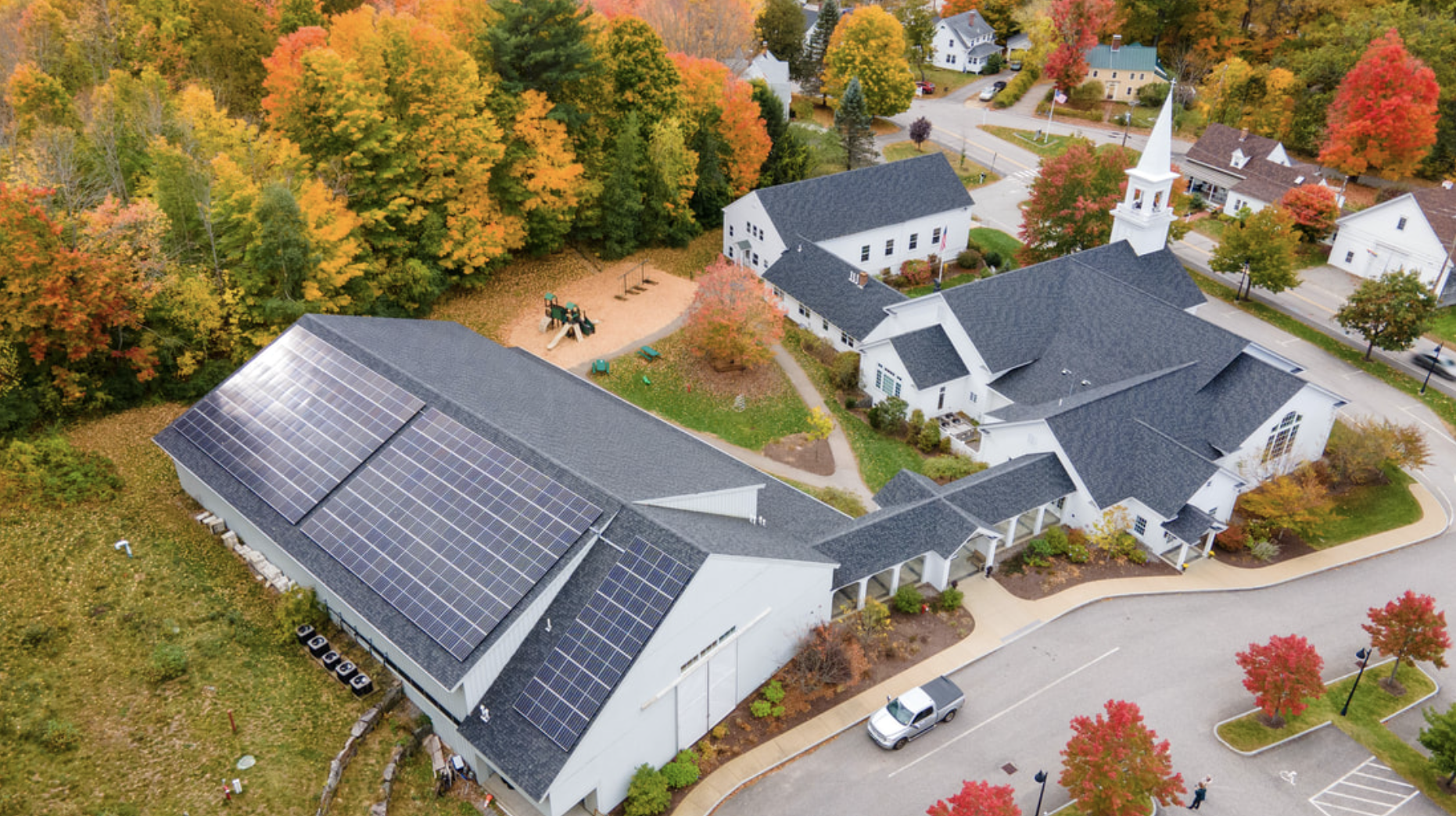
The key characteristics of solar photovoltaic systems and what makes a building a good fit.

