


Scientists urge that we must reduce our carbon emissions 50% by 2030 and be carbon neutral by 2050; in Massachusetts, this goal has been established by law. Accomplishing this will require improvements in the insulation, heating systems, and other aspects of our houses of worship. These can be expensive projects and houses of worship are often challenged to find a way to pay for big capital improvement projects. However, efficiency can become largely self-financing, if planned for and managed carefully. This Everyday Environmental Stewardship Brief will recommend mechanisms a house of worship should establish and processes it should follow to build a strong financial foundation for these projects. While our primary focus is on energy, we include water because it is another scarce resource that we should steward carefully.
Most houses of worship focus on an annual budget. But the planning and implementation of these projects will take place over several years so the financial, property, and governing teams should work together to establish anticipated energy, water, and sewer costs for at least five years. Below is an example based on expenses MassIPL sees in a typical house of worship:
Assuming 3% annual inflation, costs increase from $23,600 to $26,562 per year from 2021 to 2025 if no efficiency projects are implemented.

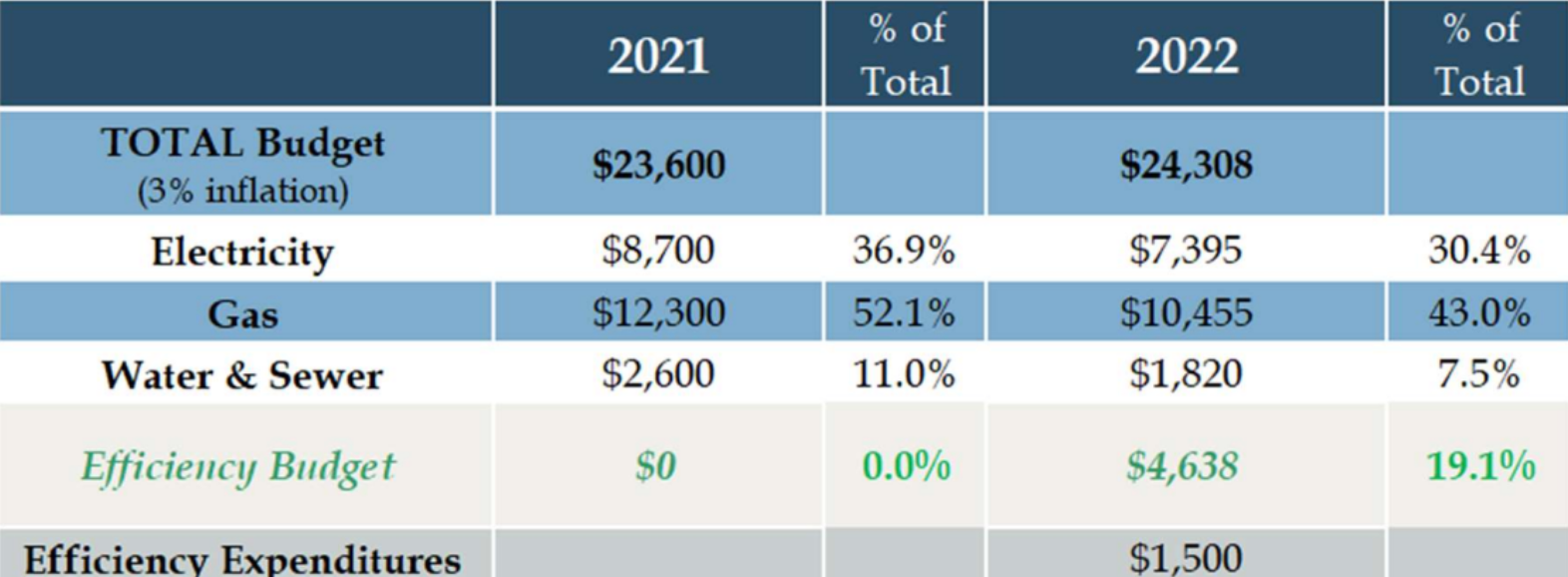
Of course, you can fund this budget line as you build your budget. Even a few hundred dollars can give you money for some simple changes: LED light bulbs, faucet aerators, insulating hot water pipes, etc. But for 2022, this wise house of worship decides to sign up for bulk buying discounts for their gas and electricity and plans to use the savings fully to implement a number of modest, simple actions to save energy and water costs. Between the discount pricing and the efficiency reductions, the house of worship anticipates savings of $4,638 and they use this money to fund the "Efficiency Budget" line item in the budget. Note that the 2022 Total Budget remains the same as they had calculated previously assuming no efficiency actions:
One bulk buying program that any house of worship in Massachusetts can participate in is Power Options https://poweroptions.org/, the largest non-profit energy consortium in New England; savings of 10% or more on electricity and gas bills are common. Another option is to buy solar electricity from a community solar provider. MassIPL's partner, EnergySage, provides an easy site to search for solar farms in your area: https://communitysolar.energysage.com/. You can save 5–10% of the cost and, of course, solar electricity is renewable!
The house of worship used some of the savings to replace old inefficient toilets with dual-flush fixtures, installed low-flow aerators in faucets, and smart thermostats to better control heating and cooling. Members also changed their behavior, being more conscious of turning off lights when leaving rooms and ensuring that the thermostats are programmed correctly. Together, these behavior changes reduce energy and water expenses another 9%.
Since this house of worship only spent $1500 of the $4638 savings on these efficiency measures, they had a surplus of $3138. Rather than cut the budget, the treasurer created an Efficiency Reserve Fund so these savings will be available for future investments.
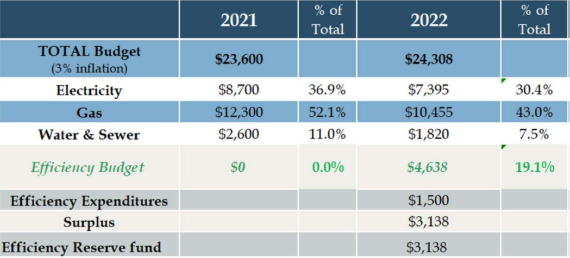
In 2023 through 2025, the house of worship begins the budget process with what the energy and water expenses would have been if they had taken no efficiency actions, using the difference between this budget number and actual expenses to continue to fund the Efficiency Budget and the Efficiency Reserve Fund. As efficiency actions reduce electricity, gas, and water costs further, the Efficiency Budget increases and pays for larger, more expensive projects that result in even bigger savings.
To achieve their goal of lowering their carbon emissions 50% or more by 2030, they aim to replace their heating and cooling equipment with energy efficient and lower carbon emissions air source heat pumps. In 2025, the house of worship uses $5000 to hire a mechanical engineer to develop specifications for their new system and by the end of the year has nearly $24,000 in the Efficiency Reserve Fund for this project.
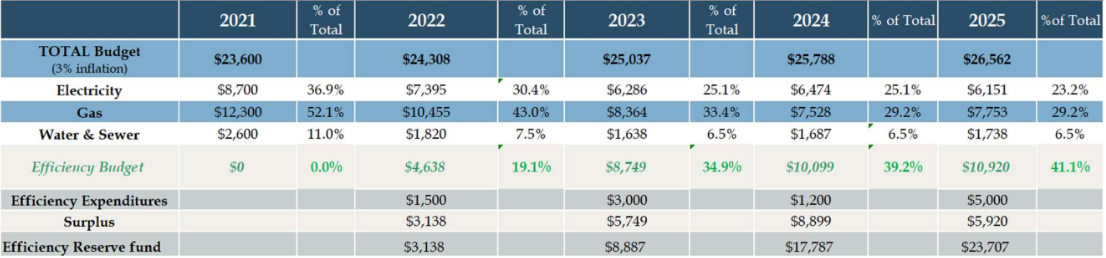
While the new heating system costs more than this, the amount they must raise from members or borrow is substantially less.
Economists across the political spectrum agree that a carbon tax, i.e., a fee imposed for every ton of carbon emission a home or organization is responsible for, would be a powerful tool to encourage people to seek more efficient, lower carbon emitting equipment. But people generally oppose new taxes and even though Massachusetts debated a carbon tax for a number of years, it was not possible to build a legislative majority to enact this policy.
But over 2000 corporations including National Grid, Nestle, and Unilever are adopting an internal carbon price to factor potential impact on the climate crisis into business decisions such as expanding their business or launching new products.¹ In addition, 40 countries as well as 20 cities, states, and provinces have instituted carbon pricing policies.²
If you choose to adopt an internal carbon price, how much should it be? The Interagency Working Group under the Biden Administration set a price of $51 per ton for the "social cost of carbon," i.e., the cost of the damage associated with carbon emissions.³ Regulatory agencies of the government use this number in their cost/benefit analyses of new regulations. Economists call this "internalizing costs", but as people of faith we should consider this as accepting responsibility for our contribution to climate change and changing our behavior to do better going forward.
If our example house of worship adopted this cost for their internal cost of carbon, they would budget an additional $2750 contribution to their Efficiency Reserve Fund. But this may be too much to add to the budget in one year. So they could follow Canada's example and begin at a lower cost and increase it each year: Canada's carbon tax started at $10 per ton, rising $10 per ton each year until it hits $50/ton. In this case, our house of worship would contribute $550 for its 2022 budget, $1100 in 2023. Knowing that this cost will increase each year gives them additional incentive to accelerate efficiency actions before the highest 'tax' rate kicks in!
The specifics of your house of worship will naturally differ from this hypothetical example. Some of the actions here will be relevant to your house of worship but there may be other higher priority projects for you than those listed here. But the principle is the same: reduce energy and water use and reinvest the savings from the lower bills into additional efficiency measures until you have achieved as much efficiency, and as low carbon emissions, as you can!
MassIPL can help you adapt this plan to your circumstances. Email info@MassIPL.org.
Want to print, share, or view this article offline? Click the link below to download it as stand-alone file.

Step-by-step guidance on adding storm windows where replacing a window is impossible, impractical, or expensive.
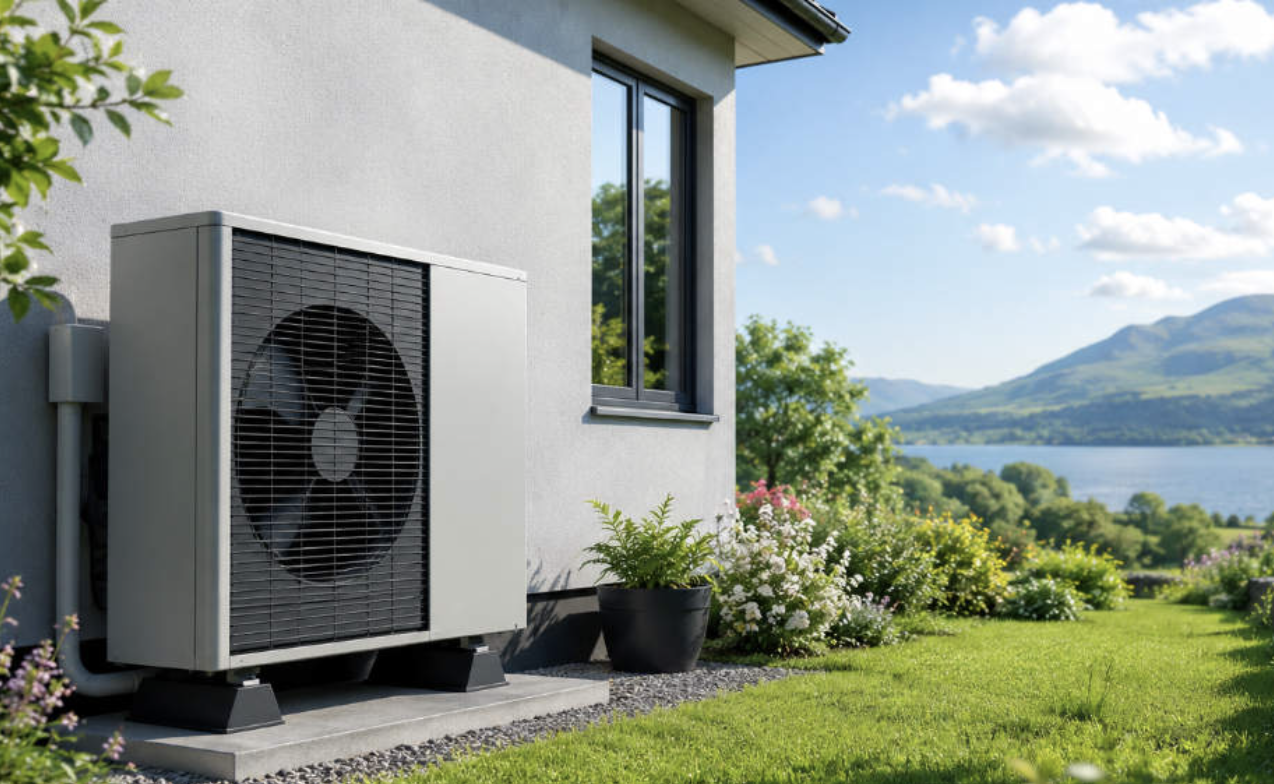
Recent efficiency gains make air-source heat pumps an excellent choice when it is time to replace a boiler or furnace. See how their cost and carbon footprint compare with oil or gas.

One of the mainstays of reducing your environmental impact. Learn the many materials and programs available.

