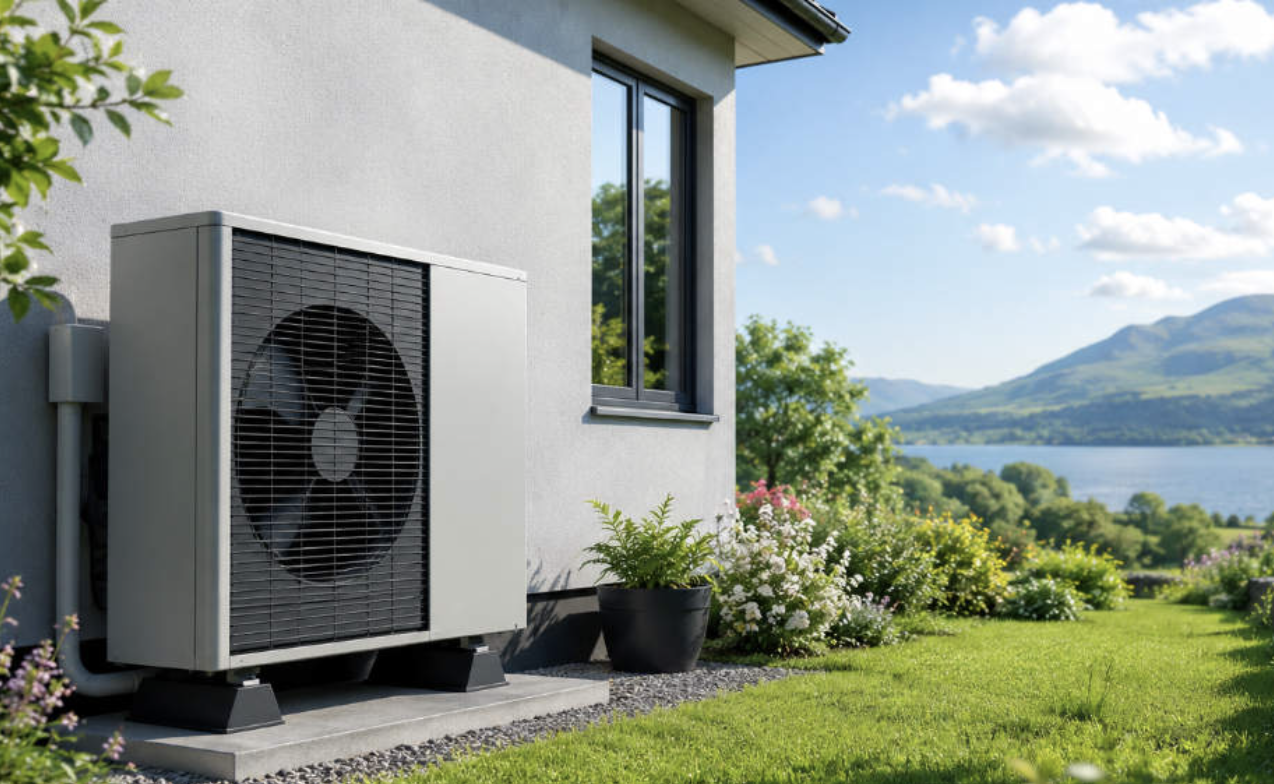


Heating and cooling is the single largest user of energy and source of carbon emissions from our Houses Of Worship (HOWs), so picking the right kind of heating and cooling system is an important environmental stewardship decision. It seems easy to replace an old system with a new one of the same type, using the same fuel—oil, natural gas, electricity or propane. However, due to recent improvements in technology, air source heat pumps offer an alternative with advantages in both cost savings and lower carbon emissions. When your HOW needs to upgrade an old system or add a new one, consider an air source heat pump.
A heat pump may sound like an exotic new technology, but in reality it is as familiar as your refrigerator. Simply put, a heat pump moves heat from one place to another. So your refrigerator cools down by taking the heat from the inside and blowing it outside. You can feel the heat coming out from under the refrigerator when it is working. Air conditioners work by a similar principle, using an electrically driven compressor to cool your living room while blowing hot air outside. So, if you reverse the process, you can heat your living areas. The equipment for doing both heating and cooling is called a heat pump.
A heat pump needs a source to extract heat from in the winter and a place to dissipate the heat it removes from the rooms in summer. This source is called a "heat sink". An air source heat pump uses outside air as the heat sink. Even in the winter, when it is "cold" to us, the air still contains heat, though as it gets colder and there is less heat in the air, standard heat pumps generate less heat; cold climate heat pumps continue to produce heat efficiently down to 0°F. A geothermal heat pump uses water pumped through the ground as the heat sink. Geothermal advantages include higher efficiency (since the ground stays at a constant temperature), less maintenance cost, and a constant capacity, but the upfront cost is higher.
Heat pumps offer both cost savings and lower emissions of carbon pollution that contribute to climate change.
Recent increases in efficiency of air-source heat pumps have reduced the amount of electricity they use so their cost is now competitive with heating with natural gas and significantly lower than oil and propane. How competitive depends on the local cost of electricity, which in Massachusetts can vary from 11 > 21¢/kWh. In most cases, the lower fuel cost can pay for the extra upfront equipment cost of heat pumps over the long run, depending on specific factors of the building it services. Of course, if the user has solar electric panels, the cost of electricity can be nothing. Moreover when AC is needed is often the time when the sun is hottest, thus generating the most electricity.
Heat pumps can also produce less carbon pollution. Since they use electricity, the carbon emissions are dependent on how much electricity they use and which fossil fuels (coal, oil, natural gas) are used to generate the electricity. Massachusetts has reduced its use of coal and oil for generating electricity so the pollution and greenhouse gases associated with heating with heat pumps has also dropped tremendously. Combining this with improved heat pump efficiency means they are now less polluting than natural gas and will get even cleaner as more clean renewable electricity (especially solar) is added to the mix.
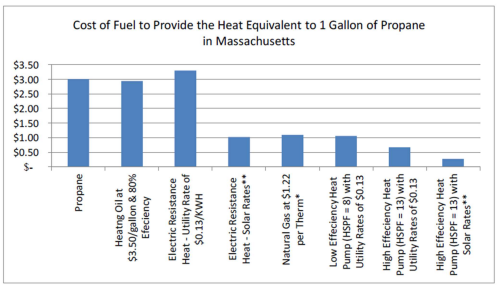
* Based on average Amherst MA retail cost for 1st 9 months of 2013
** Based on expected inflation adjusted levelized cost for South Congregational Church in Amherst
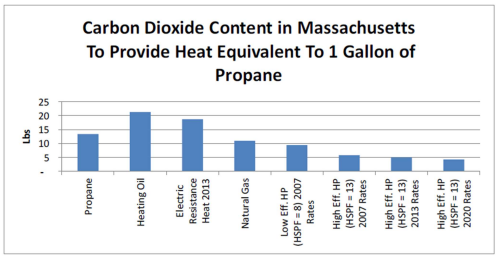
The graphs above show that electric heat pumps have surpassed natural gas and propane as an inexpensive and clean option for heating in Massachusetts.
Of course, we can be proactive and install our own clean renewable energy source such as solar panels. MassIPL can provide assistance to HOWs interested in solar, as over 100 HOWs in Massachusetts (such as South Congregational Church in Amherst) have already done.
Heat pumps also gain efficiency and improve comfort by running more consistently and adapting to the outside temperature. Old furnaces, boilers, and air conditioners (and some new ones) have one speed; the unit is either on or off. Because they are typically designed to be able to provide enough heat on the coldest day of the year, most of the year the heat source runs only a fraction of the time. The temperature in the room fluctuates by a few degrees in between run times. The most efficient new heat pump units use variable speed compressors and variable speed fans to be able to vary the amount of heat produced, thereby running longer on less cold days producing smaller temperature fluctuations. This computer control of the speed is part of how they attain higher efficiency.
The newer units also have better humidity control because of the computer-controlled variable speed fan and variable speed compressor. This can save money because a higher temperature is more comfortable if the humidity is low. For HOWs using heat pumps in sanctuaries, constant humidity can reduce the maintenance cost of the organ, both because it should stay in tune better, and because fluctuating humidity causes cracking and splitting of organ parts.
When considering whether to install a heat pump there are three key terms you need to know: (1) Coefficient of Performance, (2) Heating Seasonal Performance Factor, and (3) Seasonal Energy Efficiency Ratio. The coefficient of performance (COP) is the ratio of energy used running the compressor, fans, and pumps vs. the amount of energy delivered to the conditioned space. In the US the Heating Seasonal Performance Factor (HSPF) is the standard by which the equipment is rated. Look for a minimum HSPF of 11. The Seasonal Energy Efficiency Ratio (SEER) is the cooling season's equivalent of the HSPF; a heat pump should deliver a SEER of at least 17. In most cases you will be using 5 to 10 times as much electricity on heating as on cooling, so the HSPF is more important.
Once the heat pump generates the heated or cooled air, it needs to be distributed to rooms where it is needed. In practice there are 3 ways for the heat pump to get the heat or cold where desired. Each of the 3 identical outdoor units pictured below has one air handler inside which blows hot air through ductwork, just as a forced air furnace would.
The unit pictured above is a mini-split. Typically, there is one for each room being conditioned, though larger rooms can have more than one mini-split delivery. A mini-split also connects to an outdoor unit, though in some instances an outdoor unit can serve more than one mini-split. A real advantage of having mini-splits in each room is that each is controlled individually. Thus heating and cooling is done only when needed, by room. This is a significant improvement in both comfort and efficiency. A good starting location for this in a HOW is the office suite.
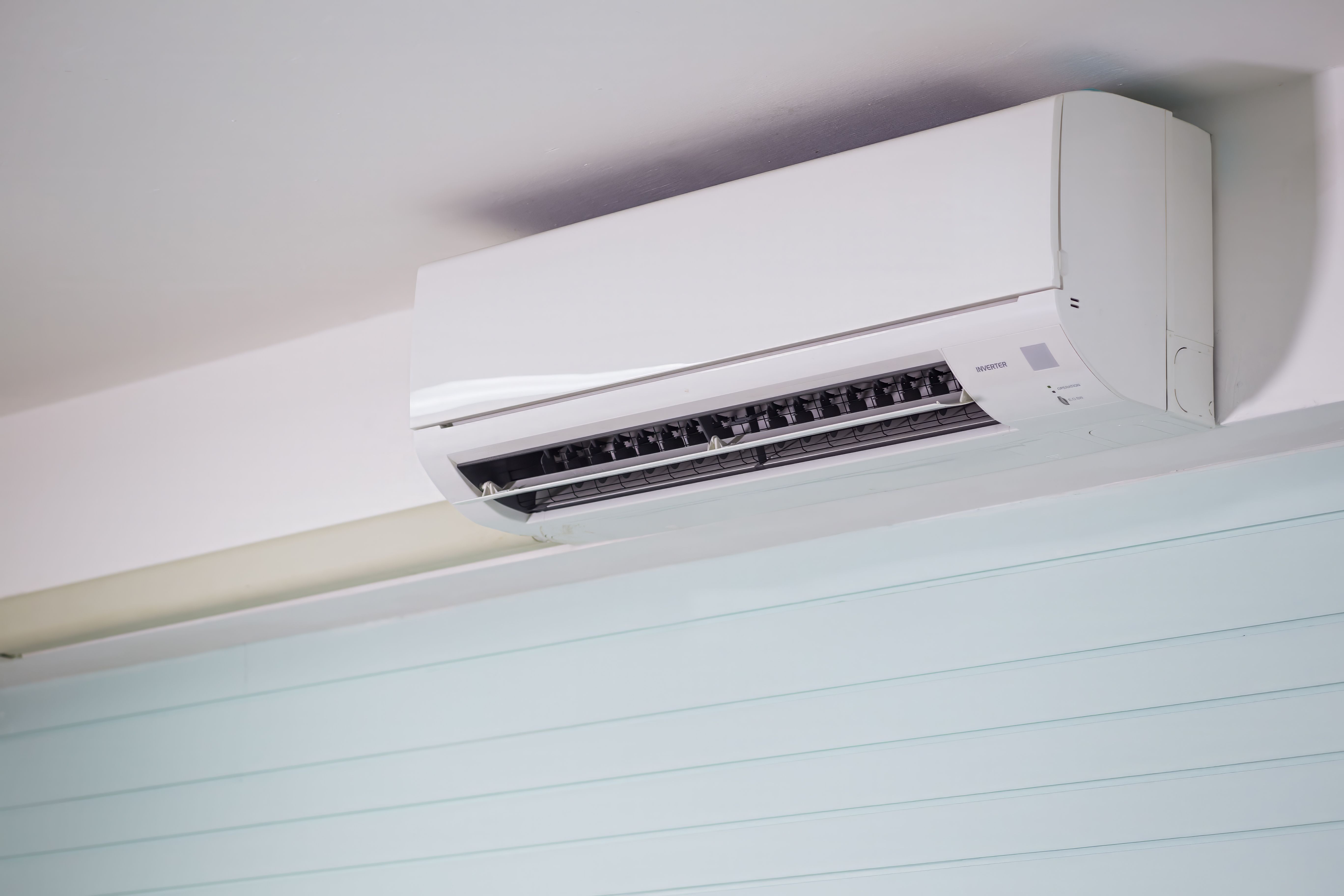
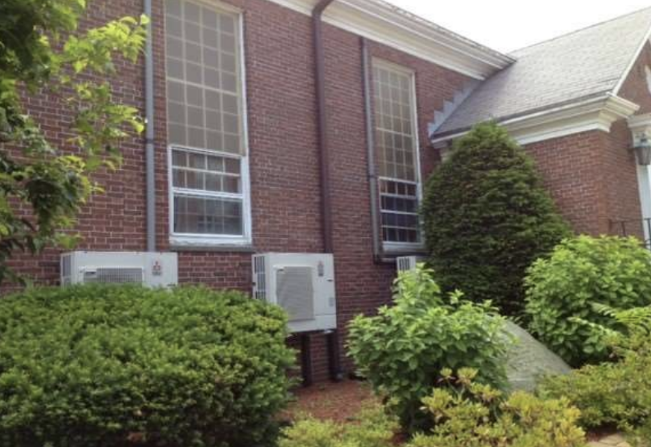
Heat pumps are now being installed in HOWs in the full range of spaces, from offices to meeting rooms and sanctuaries. The photo at left shows a wall-mounted mini-split at the upper right. It is one of several serving the space, here in conjunction with fans that move in both directions, thus serving in both winter and summer.
In some cases of historical preservation, buildings are not allowed to have the air-source heat pump outside equipment placed in a visible spot (though they can be approved if "shielded"), or sometimes not placed anywhere outside. In these cases, geothermal heat pumps can be used since after installation they don't need to have anything showing on the outside. Geothermal heat pumps are usually more expensive than air-source heat pumps and so not as good a deal but they can still be competitive with other heat sources.
Updated May 2018, October 2021
Want to print, share, or view this article offline? Click the link below to download it as stand-alone file.

Step-by-step guidance on adding storm windows where replacing a window is impossible, impractical, or expensive.

How to create a self-funding budget line for energy and water improvements, then reinvest the savings into future upgrades.

One of the mainstays of reducing your environmental impact. Learn the many materials and programs available.

